AI
The Human Act of Making Things Exist
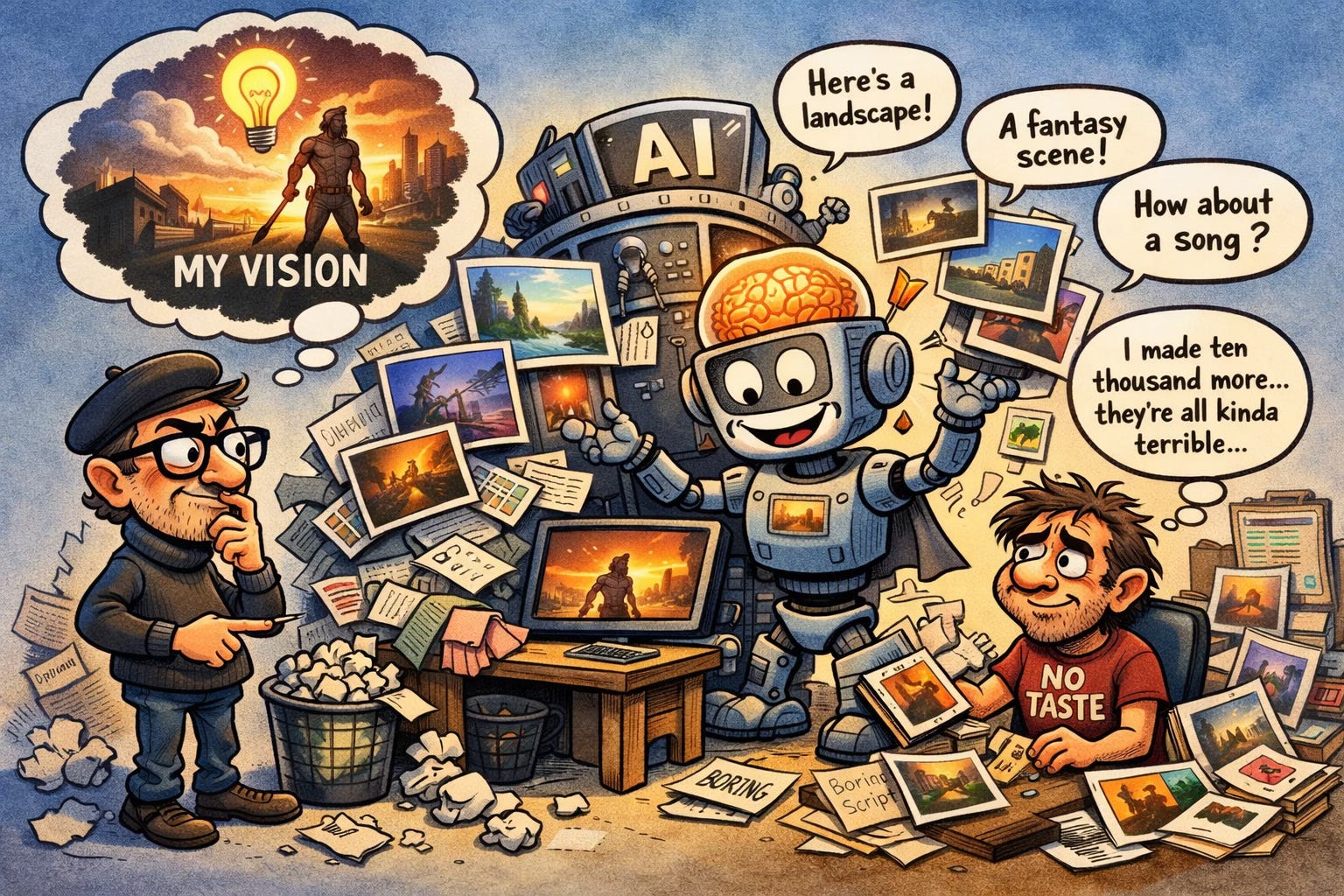
Much of the debate about AI and creativity begins with a misleading question: did the human make the work, or did the machine? The question sounds practical, but it rests on a narrow idea of authorship, one that identifies the creator mainly with manual execution. On that view, creative ownership belongs to the person who writes every sentence, draws every line, composes every note, or edits every frame by hand. Yet the history of art gives us many reasons to doubt that this was ever the whole story. Workshop traditions, apprenticeships, ghostwriting, photography, cinema, collage, sampling, and digital editing all separate conception from execution to some degree. Warhol’s Factory made authorship collective and performative rather than solitary and artisanal, while the age of mechanical reproduction had already weakened the belief that artistic value depends on the literal trace of the maker’s hand. Seen in this longer history, AI does not destroy a stable concept of authorship. It exposes that authorship was never identical with craft in the first place.
What matters more than physical execution is intention, selection, and judgment. If a work would not have existed without a particular person’s decision to bring it into being, that person still has a serious claim to authorship, even when AI performs much of the execution. A generated video, a narrated story, a synthetic voice performance, or a piece of music produced through repeated prompting does not appear because the model has something to say. It appears because someone wanted a specific thing to exist and kept working until the result matched that aim. The model offers possibilities. A human turns some of those possibilities into a work.
This Substack is reader-supported. To receive new posts and support my work, consider becoming a free or paid subscriber.
This distinction matters because possibilities are not the same as finished forms. A system can generate endless images, scenes, melodies, or paragraphs, but it cannot explain why one of them deserves to survive while the others should be deleted. It can produce abundance, but abundance alone is not creation. Creation begins when someone chooses among alternatives, rejects weaker outputs, revises promising ones, combines fragments, and measures the emerging result against an inner standard the system itself does not possess. The machine can be prolific, but it is not committed. It does not care whether an image lands emotionally, whether a line has the right cadence, or whether a scene embodies a point of view. Commitment belongs to the person who keeps pushing until the work becomes recognizable as the thing they meant to make.
At this point, taste becomes central. Taste is not just casual preference. It is a form of judgment that allows a person to recognize quality, coherence, and force even before those qualities are fully explainable. AI makes this clearer because it floods the creator with options. When production becomes easy, selection becomes hard. In that sense, AI moves scarcity from production to judgment. Two people can use the same model with access to the same tools and produce radically different results, not because one has better software, but because one brings stronger discernment to the process. One sees a pile of plausible outputs. The other sees a path toward a work.
Still, this argument needs a limit. Not every use of AI deserves the same claim to authorship. A generic prompt followed by passive acceptance of the first decent result expresses only a thin form of creative control. A stronger claim emerges when the creator iterates, rejects, recombines, edits, constrains, and directs the process over time. Consider a person making an AI-mediated short film: they may generate many voice takes, rewrite narration repeatedly, discard most visual outputs, adjust pacing and tone, and combine fragments until the final piece matches a personal vision. In such cases, the system is not replacing authorship. It is becoming the medium through which authorship operates. Authorship here is not an all-or-nothing category. It comes in degrees, just as it always has in collaborative and mediated art.
Once this qualification is made, AI looks less like a threat to authorship than a tool that clarifies where authorship actually resides. Human beings have rarely created in a pure, unassisted state. Photographers work through cameras and optics. Film directors work through actors, editors, sound designers, and cinematographers. Composers rely on instruments, performers, and production software. In each case, authorship depends less on manufacturing every element than on governing form, mood, pacing, emphasis, and meaning. AI extends this older logic by turning language, sound, and image into responsive material. It does not eliminate vision. It makes vision easier to isolate from execution.
This is why AI reveals something uncomfortable about creativity. For a long time, technical skill and artistic judgment were bundled together because the difficulty of execution filtered people before their taste could be tested. Many people may have had strong ideas or distinctive sensibilities but lacked the time, training, or resources to realize them. AI lowers that barrier. That is liberating, but it is also unforgiving. When almost anyone can generate something competent, competence alone loses prestige. The harder question becomes whether a creator can recognize what is actually good and shape it consistently enough that a personal sensibility becomes visible in the final result. AI democratizes production, but it also exposes the difference between abundance and authorship.
For this reason, the most important question about AI-mediated creativity is not whether AI can produce artifacts that resemble art. Clearly it can. The more important question is how precisely a creator can bend those artifacts toward individual intention. The future of creative AI will be decided less by raw fluency than by control: control over style, rhythm, emotional tone, composition, narrative structure, and all the subtle features through which taste enters form. A truly important creative tool is not one that merely generates content quickly. It is one that allows a person to recognize themselves in the finished work.
In the end, AI does not abolish authorship. It relocates and clarifies it. It forces us to separate creation from mere execution and to see that the heart of authorship lies in intention, judgment, selection, and the stubborn human desire to make something exist that otherwise would not have existed. That may be the most important thing AI reveals about art: not that human creators no longer matter, but that what mattered most about them was never just the labor of the hand.
This Substack is reader-supported. To receive new posts and support my work, consider becoming a free or paid subscriber.